

How Machine Learning Detects
Product Defects in Manufacturing

Related Articles
Our Customers










Introduction
Machine learning has transformed defect detection in manufacturing. Where traditional quality control relied on human inspectors or rule-based vision systems that required explicit programming for every defect type, machine learning systems learn from examples — training on images of good products to detect any deviation, including defect types that were never anticipated at setup.
This guide explains how machine learning works for defect detection, what types of defects it detects, how it compares to traditional approaches, and what manufacturers are achieving with it across automotive, pharmaceutical, electronics, and FMCG production lines.
Why Machine Learning Outperforms Traditional Defect Detection
Learns from examples
Machine learning models are trained on images of good products — they learn what normal looks like and detect any deviation. No defect catalogue needed. Novel defect types are detected automatically without reprogramming.
Handles variability
Manufacturing products have natural, acceptable variation — surface texture, colour, and dimensional tolerance. Machine learning distinguishes acceptable variation from genuine defects, dramatically reducing false positives that plague rule-based systems.
Improves continuously
Unlike rule-based systems that are static, machine learning models improve with new production data. Active learning pipelines retrain models on new defect examples and product variants, maintaining accuracy as products and processes evolve.
Scales across products
A single machine learning platform can inspect thousands of different product SKUs. Each SKU trains its own model in under an hour. One system replaces multiple legacy rule-based vision systems across an entire production facility.
How Machine Learning Defect Detection Works
Machine learning defect detection is built on convolutional neural networks (CNNs) — deep learning architectures designed to analyse visual data. The training process works as follows:
Data collection: Images of good products are captured under the production lighting and camera configuration that will be used for inspection. Typically 100–500 images are sufficient for initial model training with modern AI inspection platforms. No defect images are required at the start — the model learns to detect deviation from normal.
Model training: The CNN is trained on the good product images. It learns the distribution of normal appearance across the product surface — colour, texture, geometry, and their acceptable variation. This training process takes under an hour with modern AI inspection platforms.
Inference: During production, the trained model analyses every captured image in milliseconds. It assigns a defect probability score to each image region and makes a pass/fail classification. Regions with high defect probability are highlighted for operator review and used to trigger rejection.
Active learning: As production continues, new images — including any defect examples encountered — are fed back into the training pipeline. The model retrains on the expanded dataset, improving its discrimination between defects and acceptable variation over time. This continuous improvement loop means machine learning inspection systems get better the longer they run.
What Machine Learning Detects — Defect Types and Applications
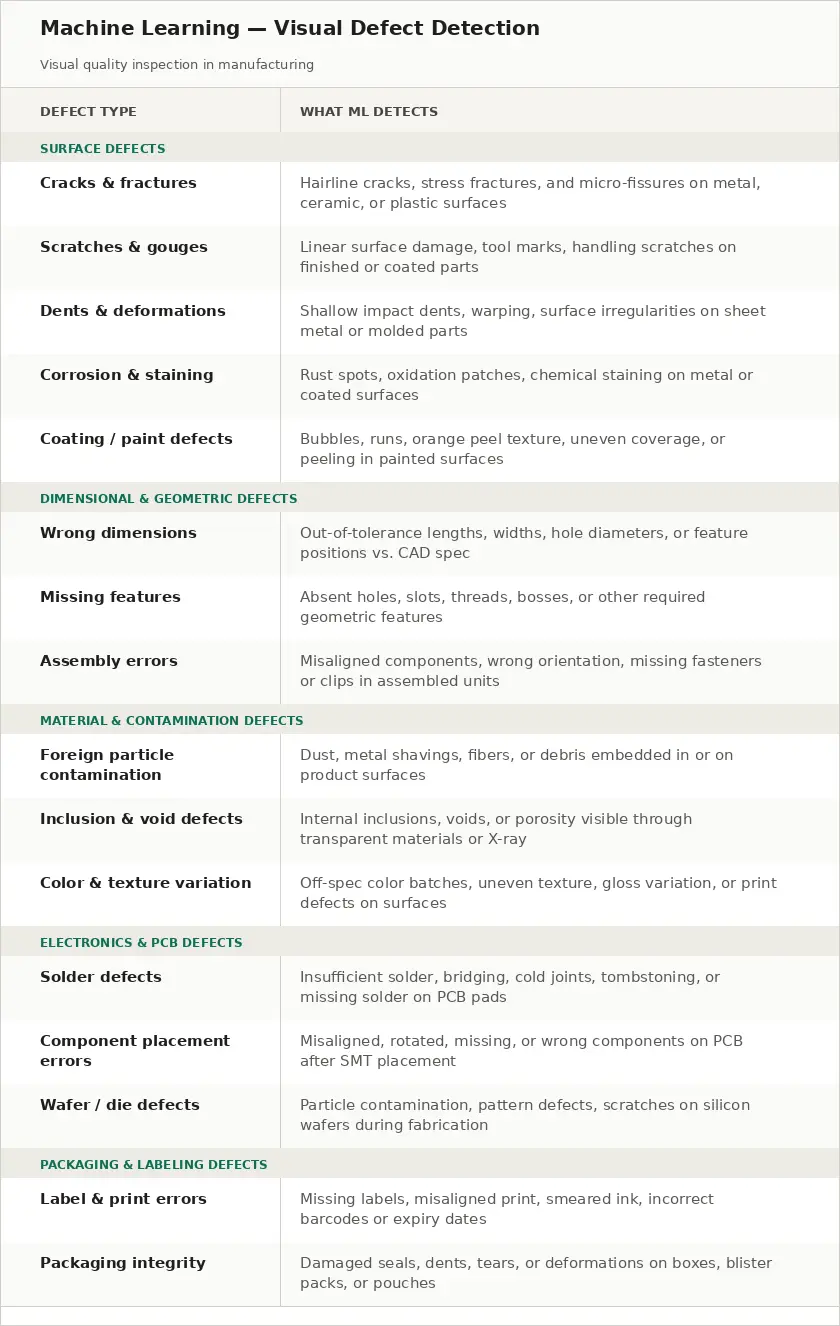
Machine Learning vs Rule-Based Defect Detection — A Direct Comparison
Rule-based defect detection requires engineers to explicitly program every detection rule. For a scratch defect, the engineer defines: the region of interest, the contrast threshold, the minimum pixel count, the shape constraints. This works for simple, stable defect types under controlled conditions. But real manufacturing defects are complex: scratches vary in depth, width, length, and orientation; contamination appears in unpredictable locations and forms; assembly errors manifest in multiple ways.
Machine learning defect detection learns these complexities from examples rather than explicit programming. The model captures the full distribution of normal appearance and the statistical boundaries of acceptable variation. Any image region that falls outside these boundaries is flagged as a potential defect — regardless of whether that specific defect type was anticipated at setup.
The practical advantages are decisive: machine learning systems detect novel defects without reprogramming; they handle acceptable product variation without excessive false positives; new products train in hours rather than weeks; and continuous active learning means accuracy improves over time rather than degrading as products and processes evolve.
DeepInspect®- Best Machine Vision Software for Defect Detection
DeepInspect® is SwitchOn’s flagship AI-powered visual inspection platform, developed in-house to address real-world manufacturing quality challenges. It enables manufacturers to move toward zero-defect production through intelligent automation, replacing manual inspection and rigid rule-based systems with adaptive AI.
What sets DeepInspect® apart is its ability to deliver high accuracy at scale—achieving up to 99.5% defect detection accuracy even for complex surface and internal defects. Unlike traditional systems, it has low data dependency, requiring fewer than 200 good images for training, with models that can be trained in under 45 minutes and deployed within days. The platform is hardware-agnostic, making it compatible with a wide range of camera systems, including borescopes and industrial vision setups. Beyond detection, DeepInspect provides real-time analytics that offer actionable insights into defect trends, enabling process-level improvements. Its adaptability allows it to handle variability in lighting, texture, and part orientation far better than conventional rule-based approaches. DeepInspect is trusted by leading manufacturers across automotive, FMCG, pharma, and industrial sectors.
Why DeepInspect®?
- Deep learning CNN models trained on fewer than 200 good product images
- Model training in under 45 minutes — no specialist ML expertise required
- Active learning pipeline retrains automatically on new production data
- Detects surface defects, assembly errors, dimensional deviations, packaging failures, and contamination
- 99.5% detection accuracy with false positives below 0.1%
- Supports 1,000+ unique SKUs on a single platform
- Area scan, line scan, and thermal camera support
- PLC, MES, and ERP integration
Conclusion
Machine learning has resolved the fundamental limitation of automated defect detection — the requirement to explicitly program every defect type. By learning from examples of good products, machine learning inspection systems generalise to the complexity of real manufacturing defects in a way that rule-based systems cannot.
DeepInspect® is SwitchOn’s machine learning defect detection platform. It trains in under 45 minutes on images of good products, deploys in under a day, and continuously improves through active learning as production data accumulates. For any manufacturer looking to move beyond the limitations of manual inspection or rule-based machine vision, it provides the most accessible path to production-grade AI defect detection.
Let's Discuss How We Can Transform Your Operations!
Want to see machine learning defect detection on your product? We can run a trial on your production line.
Inquiry Form
Machine learning detects manufacturing defects by training a deep learning model on images of good products. The model learns the distribution of normal product appearance and flags any region that deviates — whether or not that specific defect type was seen during training. During production it analyses every captured image in milliseconds.
Machine learning defect detection handles: surface anomalies (scratches, cracks, dents, stains), assembly errors (missing components, wrong orientation), dimensional deviations (size, shape, position out of tolerance), packaging defects (seal failures, fill level, cap presence, label accuracy), and contamination (foreign particles, inclusions, residue).
Modern AI inspection platforms like DeepInspect® require fewer than 200 images of good products for initial training — no defect images needed at setup. As production runs, defect examples are added through active learning, improving the model over time.
Active learning is the process by which a machine learning defect detection model improves continuously from production data. When the model encounters an uncertain image, it flags it for operator review. The operator's classification is added to the training dataset and the model periodically retrains — becoming more accurate the longer it operates in production.
Yes. By training only on images of good products, the system learns what normal looks like and detects any deviation. As production runs and defects are encountered, these examples are incorporated into retraining to improve discrimination between defects and acceptable variation.