

How AI is Transforming
Manufacturing Quality Control

Related Articles
Our Customers








Introduction
Manufacturing quality control has relied on human inspectors and rule-based machine vision for decades. Both have delivered value — but both have structural limits. Human inspectors fatigue. Rule-based systems break when conditions change. And neither can deliver 100% inspection coverage at modern production speeds.
Artificial intelligence is changing this. AI-powered visual inspection systems learn what a good product looks like, detect any deviation in real time, and improve continuously with new production data. This guide explains how AI is transforming manufacturing quality control — what it replaces, what it adds, and what manufacturers are achieving with it.
What AI Brings to Manufacturing Quality Control
Speed
AI vision systems inspect products in under 10 milliseconds — far faster than any human inspector. At 1,000 units per minute, AI makes 100% inspection achievable where only sampling was possible before.
Accuracy
Deep learning models trained on good product images detect surface defects, assembly errors, and contamination at accuracies exceeding 99% — consistent across every shift, every line, every site.
Adaptability
Unlike rule-based systems, AI learns what good looks like. When products or defect types change, the model retrains in under an hour — no machine vision engineer required.
Traceability
Every inspection is logged with timestamp, image, and result. AI quality control generates the digital audit trail that FDA, EU GMP, IATF 16949, and FSMA compliance requires.
How AI Quality Control Works in Manufacturing
AI manufacturing quality control is built on deep learning — specifically convolutional neural networks (CNNs) trained on images of good products. The system learns the full distribution of acceptable product appearance: what surface texture, colour variation, edge sharpness, and geometry look like when a product is conforming.
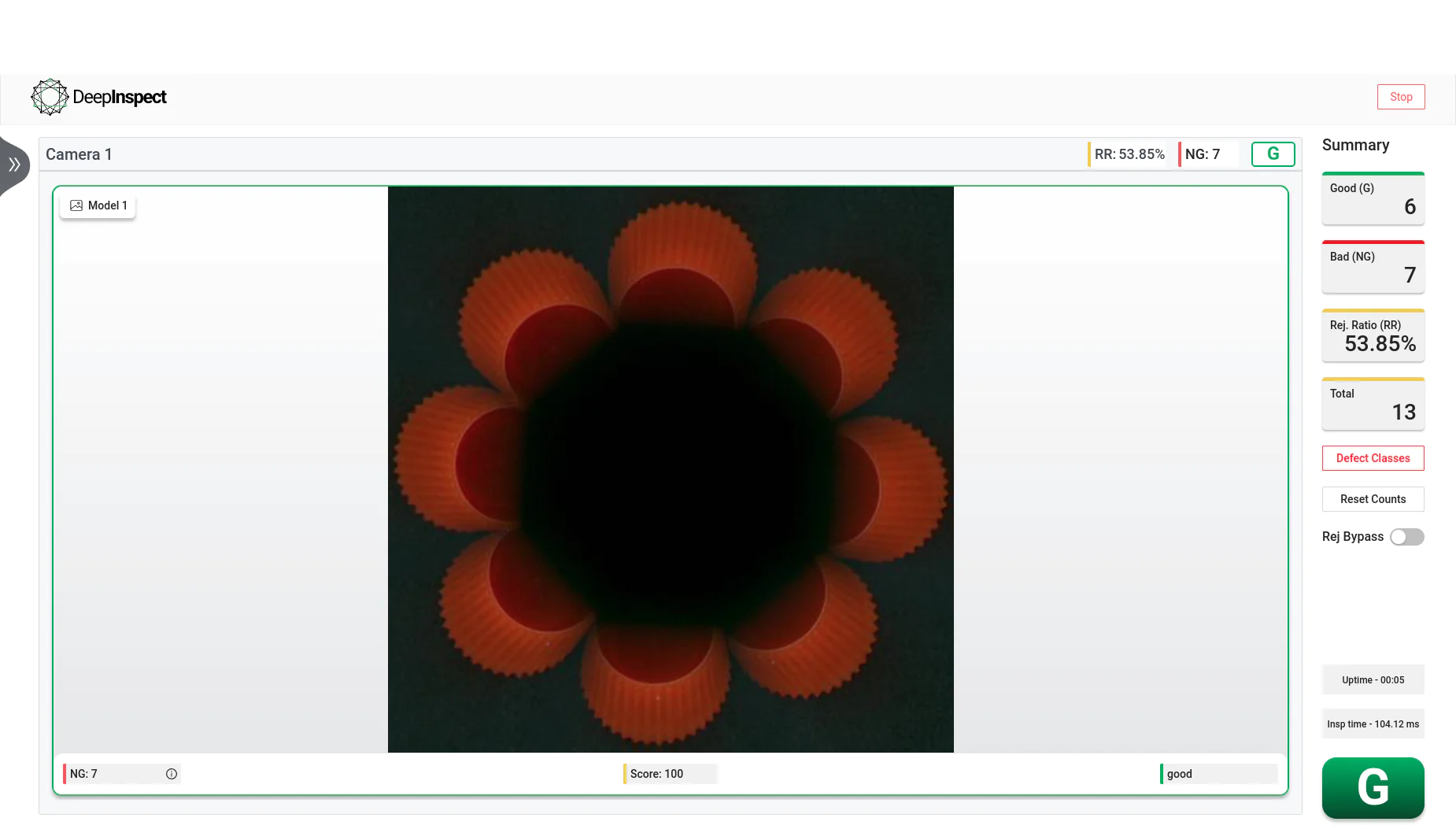
During production, industrial cameras capture images of every unit passing the inspection point. The trained AI model analyses each image in milliseconds and classifies it as pass or fail. If a defect is detected — a scratch, a misaligned label, a missing component, a seal failure — the unit is automatically rejected. Every inspection result is logged with the captured image, timestamp, defect type, and confidence score.
Unlike rule-based machine vision, AI does not need engineers to define what each defect looks like. It detects any deviation from normal — including defect types that were never anticipated at setup. This is the fundamental capability shift that makes AI manufacturing quality control qualitatively different from what preceded it.
What AI Quality Control Detects
Ready to move from sampling-based inspection to 100% AI visual quality control? Talk to our team.
Why Traditional Quality Control Fails at Modern Production Speeds
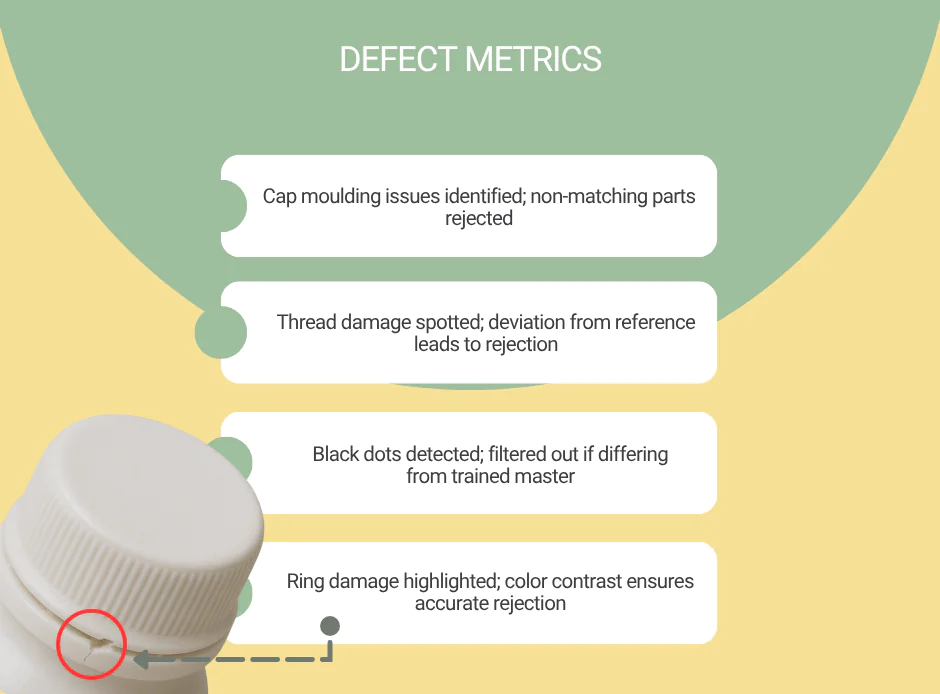
Rule-Based vs AI Quality Control — The Key Differences
Traditional machine vision requires engineers to explicitly program every inspection rule. This takes weeks to deploy, requires specialist expertise, and breaks when products or defect types change. Every new product variant or new defect type requires re-engineering — and the system can only detect defects it was taught to recognise.
AI quality control inverts this. You show the system images of good products. It learns what normal looks like and flags anything that deviates. New products train in hours, not weeks. Novel defects are detected without explicit programming. And AI systems continuously improve through active learning as new production data is added.
The ROI case is clear: reduced scrap and rework costs, fewer customer complaints and recalls, lower inspection labour costs, and the compliance documentation that regulated industries require.
Why DeepInspect®?
- Trains on fewer than 200 good product images — no defect images required at setup
- AI model training in under 45 minutes, line trial within 1 day
- 99.5% defect detection accuracy with false positives below 0.1%
- Supports area scan, line scan, and thermal cameras
- Inspects up to 1,000 parts per minute
- Integrates with PLC, MES, and ERP systems
- Deployed across 1,000+ SKUs in automotive, pharma, FMCG, and electronics
Conclusion
AI is not a future technology in manufacturing quality control — it is being deployed on production lines today across automotive, pharmaceutical, food and beverage, electronics, and FMCG manufacturing. The manufacturers adopting it are achieving 100% inspection coverage, sub-0.1% false positive rates, and full digital traceability at production speeds that make manual inspection impossible.
DeepInspect® by SwitchOn is purpose-built for this transition — from manual or rule-based inspection to AI-powered visual quality control that deploys in days and improves continuously.
Let's Discuss How We Can Transform Your Operations!
FAQ’s :
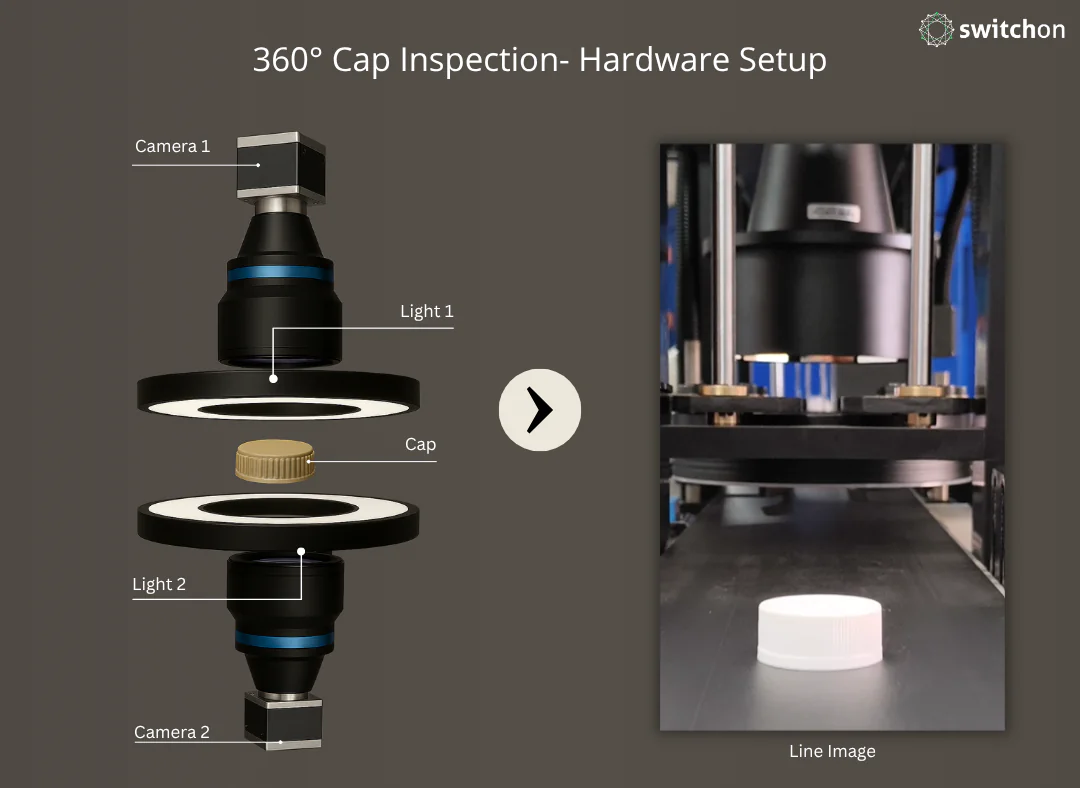
DeepInspect uses readily available industrial-grade hardware to ensure high repeatability and long lifespan. We provide a basic kit to help you get started, which includes a controller, camera, lights, and a PLC.
DeepInspect supports inspection speeds of up to 1000 parts per minute. The final speed depends on various factors, such as the number of cameras, lighting, and other line conditions. If you have a requirement above 1000 PPM, please contact us.
DeepInspect supports all GenICam-compliant USB 3.0 and GigE cameras, giving you the flexibility to work with the hardware you already have on your production line. Fully tested and compatible brands include Basler, IDS, Baumer, Omron Sentech, Allied Vision, FLIR, HIK Robot, and Lucid Vision. We also support Area Scan, Line Scan, and Thermal cameras, covering a wide range of inspection environments and product types.
DeepInspect is built specifically for defects that are random and unpredictable in nature, such as cracks, scratches, surface anomalies, missing components, seal failures, and label errors. Unlike rule-based systems that rely on a defect appearing at a fixed location or in a fixed pattern, DeepInspect uses AI models trained on your actual production data to recognize defects regardless of where they appear or how they look. This is exactly where AI inspection becomes critical: when a crack can appear anywhere on a part, or a scratch has no consistent shape or size, traditional vision systems fail. DeepInspect is trained to catch what others miss. The system has been successfully deployed across over 1,000 unique SKUs in automotive, pharma, electronics, and FMCG industries.
AI quality control in manufacturing uses deep learning models and computer vision to inspect products on production lines in real time. The AI learns what a conforming product looks like and automatically detects any deviation — surface defects, assembly errors, dimensional failures, packaging defects, and contamination — without explicit rule programming.
Traditional machine vision requires engineers to manually program every detection rule — it only catches defects it was explicitly taught to find. AI quality control trains a deep learning model on images of good products and detects any deviation, including novel defect types never anticipated at setup. AI deploys faster, handles product variation better, and requires no specialist reprogramming when products change.
AI quality control is used across automotive, pharmaceuticals, food and beverage, electronics, and FMCG packaging — any industry manufacturing physical products at volume where consistent, traceable quality inspection is required.
With DeepInspect®, a line trial can be completed within 1 day. Model training on fewer than 200 good product images takes under 45 minutes. Full production deployment including PLC integration typically takes 1–3 days depending on line complexity.
ROI comes from reduced scrap and rework costs, fewer customer complaints and recalls, lower inspection labour costs, and regulatory compliance cost avoidance. Most manufacturers see payback within 6–18 months depending on production volume and defect rates.