

Technical Guide to Line Scan Camera Systems in Industrial Manufacturing
Related Articles
Our Customers









Introduction
In the industrial machine vision landscape, the transition from manual quality control to automated optical inspection (AOI) has been driven by the need for speed, precision, and repeatability. While area scan cameras—which capture a fixed rectangular frame—are ubiquitous, they often fail to meet the rigorous demands of high-speed, continuous production environments.
This is where Line Scan Camera Technology becomes the critical differentiator. This technical document explores the architecture, advantages, and high-stakes applications of line scan systems across four pillar industries: Pharmaceuticals, FMCG, Electronics, and Automotive.
What is a Line Scan Camera? An Architectural Overview
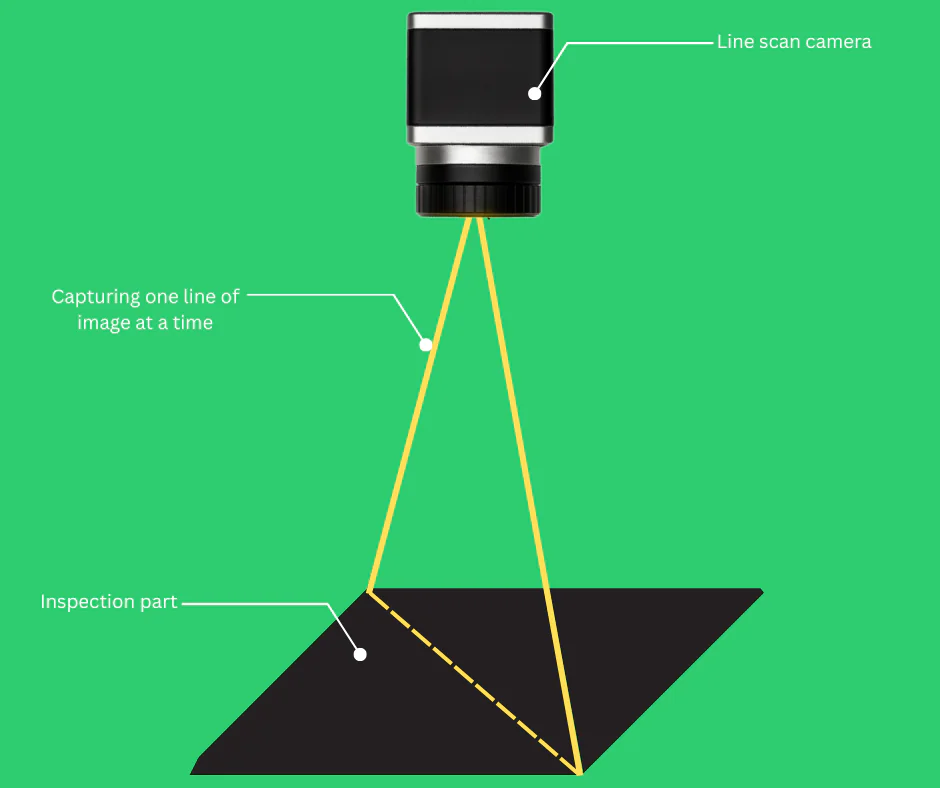
A line scan camera is a specialized imaging device that contains a single row of photosensitive pixels (photodiodes) rather than a 2D matrix. To generate a two-dimensional image, there must be relative motion between the camera and the object.
The Mechanics of Image Formation
As an object passes under the camera, the sensor captures one “slice” of the object at a time. These slices are then buffered and stitched together by a frame grabber or onboard FPGA (Field Programmable Gate Array) to form a seamless, continuous image.
Sensor Resolution: Linear sensors typically range from 512 pixels to 16,384 pixels (16k) in width.
Line Rate: The frequency at which the camera captures lines, measured in Kilohertz (kHz). A 100 kHz camera captures 100,000 lines per second.
The Encoder Factor: To prevent the image from appearing stretched or compressed, the camera’s line rate must be perfectly synchronized with the conveyor’s speed. This is achieved using a Rotary Encoder, which sends pulses to the camera to trigger a line capture for every millimeter of travel.
Image Capturing in Line Scan Cameras
Why Choose Line Scan Technology?
Manufacturing engineers opt for line scan systems when area scan cameras reach their physical limitations.
A. Infinite Vertical Resolution
Area scan cameras are limited by their vertical pixel count (e.g., 4000 x 3000 pixels). If you are inspecting a continuous roll of plastic film or a 2-meter-long automotive chassis, an area scan camera would require multiple shots and complex software “stitching” that often results in artifacts. A line scan camera can produce an image that is 16,000 pixels wide and virtually infinite in length.
B. Elimination of Perspective Distortion
Because a line scan camera only looks at a narrow “slit” of the object directly beneath the lens, it avoids the spherical distortion (the “fisheye” effect) common at the edges of area scan images. This ensures that measurements taken at the edge of the belt are as accurate as those in the center.
C. Superior Lighting Control
Lighting a large 2D area uniformly is a significant engineering challenge. Line scan cameras only require the illumination of a thin 1D line. This allows for the use of high-intensity Line Lights that focus light exactly where the sensor is looking, drastically improving the Signal-to-Noise Ratio (SNR) and allowing for much faster shutter speeds.
Core Technical Advantages of Line Scan Cameras
TDI (Time Delay Integration): In low-light environments or ultra-high-speed lines, a single line exposure may not gather enough photons. TDI sensors use multiple rows (up to 256) to capture the same object line as it moves. The charges are electronically shifted and summed in sync with the motion, multiplying sensitivity without increasing noise.
100% Surface Coverage: Line scan imaging ensures no “blind spots.” In area scan, if the shutter isn’t perfectly timed, a defect can fall between two frames. Line scan captures every single millimeter of the passing surface.
Sub-pixel Accuracy: Due to the high horizontal resolution (up to 16k), these cameras provide incredible spatial resolution, allowing systems to detect defects that are smaller than the human eye can perceive.
The Mathematical Foundation of Line Scan Imaging
To ensure an image is captured without being stretched or compressed, the camera’s Line Rate (Lr) must be perfectly synchronized with the Conveyor Speed (V) and the desired Spatial Resolution (R). This formula is the cornerstone of system design in high-speed manufacturing environments.
Where:
Lr (Line Rate): Measured in Hertz (Hz) or lines per second. It defines how many times the sensor must fire every second.
V (Velocity): The speed of the object or conveyor belt, typically measured in mm/s.
R (Spatial Resolution): The object-level pixel size (e.g., $0.1$ mm/pixel). This determines the smallest defect the camera can physically “see.”
When to Choose a Line Scan Camera
Choosing between a line scan camera and a traditional area scan camera is a critical decision in system design. While area scan cameras are simpler to integrate, line scan technology is the necessary choice when the application involves continuous motion, high speeds, or extreme resolution requirements.
Below are the primary technical scenarios where a line scan camera is the superior choice:
1. Inspection of Continuous Web Materials
If your production involves a continuous roll of material—such as plastic film, paper, or metal foil—an area scan camera is impractical. It would require multiple overlapping snapshots, leading to “stitching” errors and redundant data.
The Line Scan Advantage: A line scan camera captures a seamless, uninterrupted image of infinite length, ensuring 100% surface inspection without the risk of missing defects between frames.
2. Cylindrical or Rotating Objects
Capturing the surface of a 3D cylindrical object, such as a pharmaceutical vial, a beverage can, or an automotive tire, usually results in perspective distortion and glare when using a 2D camera.
The Line Scan Advantage: By rotating the object in front of a line scan camera, the system “unwraps” the curved surface into a perfectly flat 2D image. This is essential for accurate OCR on labels or detecting hairline cracks on curved glass.
3. Extreme Spatial Resolution Requirements
In industries like Electronics, defects can be measured in microns. To achieve a 16,000-pixel horizontal resolution with area scan cameras, you would need to network several high-resolution cameras together, which is costly and complex.
The Line Scan Advantage: Single-sensor line scan cameras are available in resolutions of 8k, 12k, and 16k. This allows you to inspect a wide field of view with microscopic detail in a single pass.
4. Limited Installation Space
Industrial machinery often has very tight physical constraints. An area scan camera requires a clear, wide “window” to see its entire 2D field of view.
The Line Scan Advantage: A line scan camera only needs a narrow “slit” or gap to see the object. This makes it much easier to integrate into existing conveyor systems where mechanical parts or safety guards might obstruct a full 2D view.
5. High-Speed Motion and Motion Blur
Moving objects often appear blurred in area scan images unless expensive high-speed shutters or strobe lighting are used.
The Line Scan Advantage: Because the camera captures only one line at a time with a very high line rate, and the exposure time is incredibly short, motion blur is virtually eliminated. This makes it the only viable choice for lines moving faster.
6. Challenging Lighting Environments
Lighting a large 2D area uniformly is a massive engineering challenge.
The Line Scan Advantage: You only need to illuminate a thin 1D strip. This allows for the use of high-intensity, focused Line Lights, which provide superior contrast for surface scratches and textures while consuming less power.
Strategic Industry Applications of Line Scan Cameras
I. Pharmaceutical Industry:
In pharmaceutical manufacturing, the cost of a single defective product reaching the market is astronomical, involving both legal liability and patient risk.
Application: 360-Degree Vial and Ampoule Inspection. Standard cameras struggle with the glare and curvature of glass vials. By rotating the vial in front of a line scan camera, the system “unwraps” the cylindrical surface into a perfectly flat 2D image.
Technical Benefit: This process allows for the inspection of the entire label (OCR/OCV verification), checking for hairline cracks in the glass, and ensuring the crimp seal is perfectly applied. It eliminates the distortion that occurs when trying to photograph a curved surface with a 2D sensor.
II. FMCG:
FMCG lines move at blistering speeds, often exceeding 10 meters per second.
Application: High-Speed Web and Packaging Inspection. Whether it is inspecting the print quality of a snack food pouch or the integrity of a heat-sealed lid on a yogurt cup, line scan cameras provide the necessary speed.
Technical Benefit: Line scan cameras can identify “hickeys” (ink spots) or microscopic punctures in packaging material that could lead to spoilage. Because the camera captures data continuously, it can trigger a “reject” signal to a pneumatic gate with microsecond precision, removing the defective item without stopping the line.
III. Electronics:
As electronics components shrink to the “01005” scale (0.4mm x 0.2mm), the resolution requirements for Automated Optical Inspection (AOI) have skyrocketed.
Application: Wafer and PCB Surface Inspection. In PCB assembly, line scan cameras scan the entire board in one pass to verify component placement, solder bridge defects, and polarity.
Technical Benefit: Using Color Line Scan or Multi-spectral imaging, these cameras can distinguish between the copper of a trace, the green of the solder mask, and the silver of a solder joint. The high pixel density allows the system to detect a bridge between two pins that are only microns apart.
IV. Automotive
Automotive manufacturing requires the inspection of large, often reflective, metallic parts where surface finish is critical.
Application: Brake Disc and Cylinder Bore Inspection. Inspecting the internal surface of a cylinder bore or the friction surface of a brake disc requires looking at a circular area.
Technical Benefit: By using a line scan camera in conjunction with a rotating stage, the interior of a cylinder can be “flattened” into a map. This allows for the detection of porosity in the casting or machining marks that could lead to premature engine failure. The use of specialized “Dark Field” line lighting highlights surface scratches while ignoring the natural reflectivity of the metal.
The Future of Line Scan in Industry 4.0
As manufacturing moves toward Industry 4.0, the data generated by line scan cameras becomes the “eyes” of the smart factory. The massive throughput of data (often gigabits per second) is now being processed by AI and Machine Learning algorithms to predict tool wear, optimize material usage, and guarantee 100% yield.
For any manufacturing process involving high speeds, continuous materials, or the need for microscopic detail over a large area, line scan technology is not just an alternative—it is the technical requirement for modern quality control.
Why DeepInspect® is the Best Choice for Line Scan Applications
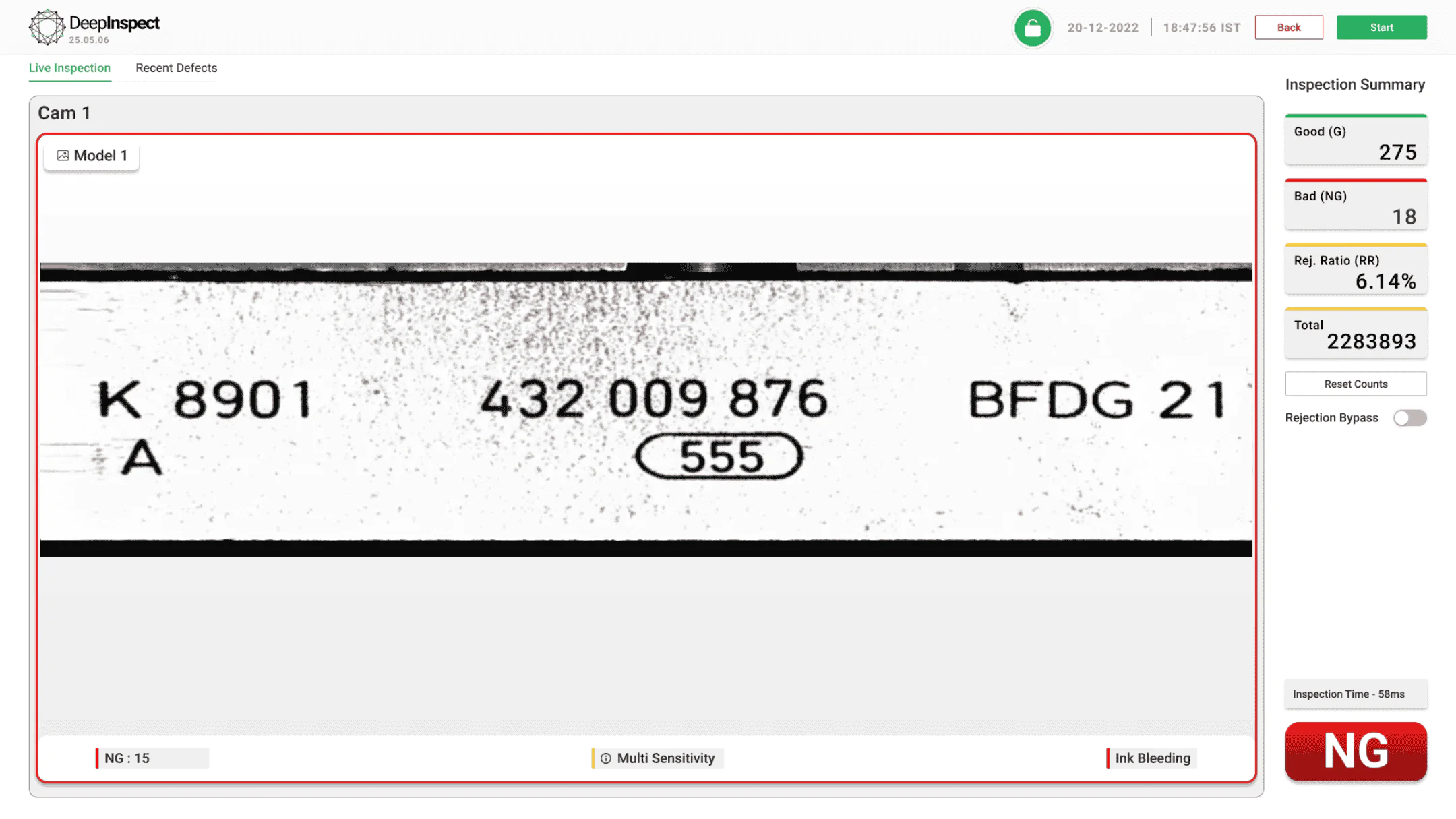
DeepInspect is the best AI-powered software designed to handle the unique complexities of line scan imaging in high-speed manufacturing. Unlike traditional vision systems that struggle with continuous data streams, DeepInspect excels through its unsupervised AI architecture, requiring fewer than 200 “good” images and zero defective samples to train a robust model.
For industries like Pharma, FMCG, Automotive, and Electronics, DeepInspect offers:
Ultra-Fast Deployment: Go from setup to a live production trial in under 45 minutes, ensuring minimal downtime.
Precision at Scale: It delivers a 99.5% detection accuracy while maintaining false positives below 0.5%, even at the extreme line rates typical of 16k line scan sensors.
Edge Analytics: Real-time data processing allows for immediate root-cause analysis, helping quality managers track defects back to specific machines without internet or cloud dependency.
By combining rapid training with distortion-free processing, DeepInspect ensures that even the most subtle surface defects on fast-moving webs or rotating cylinders are identified with scientific precision.
Why DeepInspect®?
- AI-first architecture — deep learning models outperform rule-based inspection in complex defect detection.
- Fast model training — reduces deployment time from months to hours.
- High throughput — supports enterprise-scale manufacturing speeds.
- Low false positives — improves trust and reduces manual intervention.
- Flexible hardware support and easy integration — fits into existing automation ecosystems without extensive reconfiguration.
- Broad applicability across industries and defect types, making it a versatile investment for quality assurance teams.
What Makes DeepInspect® the Best Vision AI Software?
- Requires <200 good images for model training
- End-to-end training completed in under 45 minutes
- 99.5%+ defect detection accuracy
- <0.5% false positives, outperforming rule-based tools
- Real-time inspection at very high speeds
- Line trial in just one day
- Supports line-scan, area-scan, and thermal cameras
- Robust to lighting, surface variations, and environmental noise
- Scales across factories with unified analytics and downloadable quality reports
Looking for the best Machine Vision software? Let's talk
Inquiry Form
An area scan camera captures a full 2D frame (like a snapshot) at once. A line scan camera captures an image one single pixel-row at a time. To create a 2D image with a line scan camera, the object must move past the sensor, and the individual lines are then digitally "stitched" together.
An encoder is critical for synchronization. It measures the conveyor speed and tells the camera exactly when to capture the next line. Without an encoder, any slight variation in conveyor speed would result in the final image appearing stretched (if the belt slows down) or compressed (if the belt speeds up).
You are inspecting continuous "web" materials (rolls of paper, plastic, or foil).
You need extreme resolution (e.g., 8k or 16k pixels) that a single 2D camera cannot provide.
You need to "unwrap" a cylindrical object like a vial or battery cell for 360° inspection.
The object is moving too fast for traditional area scan exposures.
Yes. Color line scan cameras typically use Trilinear sensors (three separate rows for Red, Green, and Blue) or Quadlinear sensors (RGB plus a Near-Infrared row). These provide high-fidelity color without the "Bayer pattern" interpolation artifacts often found in area scan cameras.
es. Because line scan cameras have very short exposure times, they require high-intensity lighting. However, you only need to illuminate a thin "line" across the product rather than a large area. This allows for concentrated Line Lights, which are more efficient and provide better contrast for surface defects.
No. By definition, line scan imaging requires relative motion. Either the object must move past the camera (conveyor), or the camera must be mounted on a moving gantry (like a document scanner) to build the image.
Because line scan cameras generate massive amounts of data, they often use high-bandwidth interfaces:
GigE Vision: Good for long distances (up to 100m) but lower bandwidth.
Camera Link: A reliable industrial standard for medium to high speeds.
CoaXPress (CXP): The gold standard for ultra-high-speed, high-resolution data transfer.
Line scan images can be massive and complex. DeepInspect uses AI to automatically handle the nuances of stitched images. It eliminates the need for complex manual rule-setting by learning from "Good" samples, making it easier to detect subtle defects like scratches or discoloration on continuous surfaces that traditional software might miss.