

Manual vs Automated Visual Inspection:
A Complete Comparison
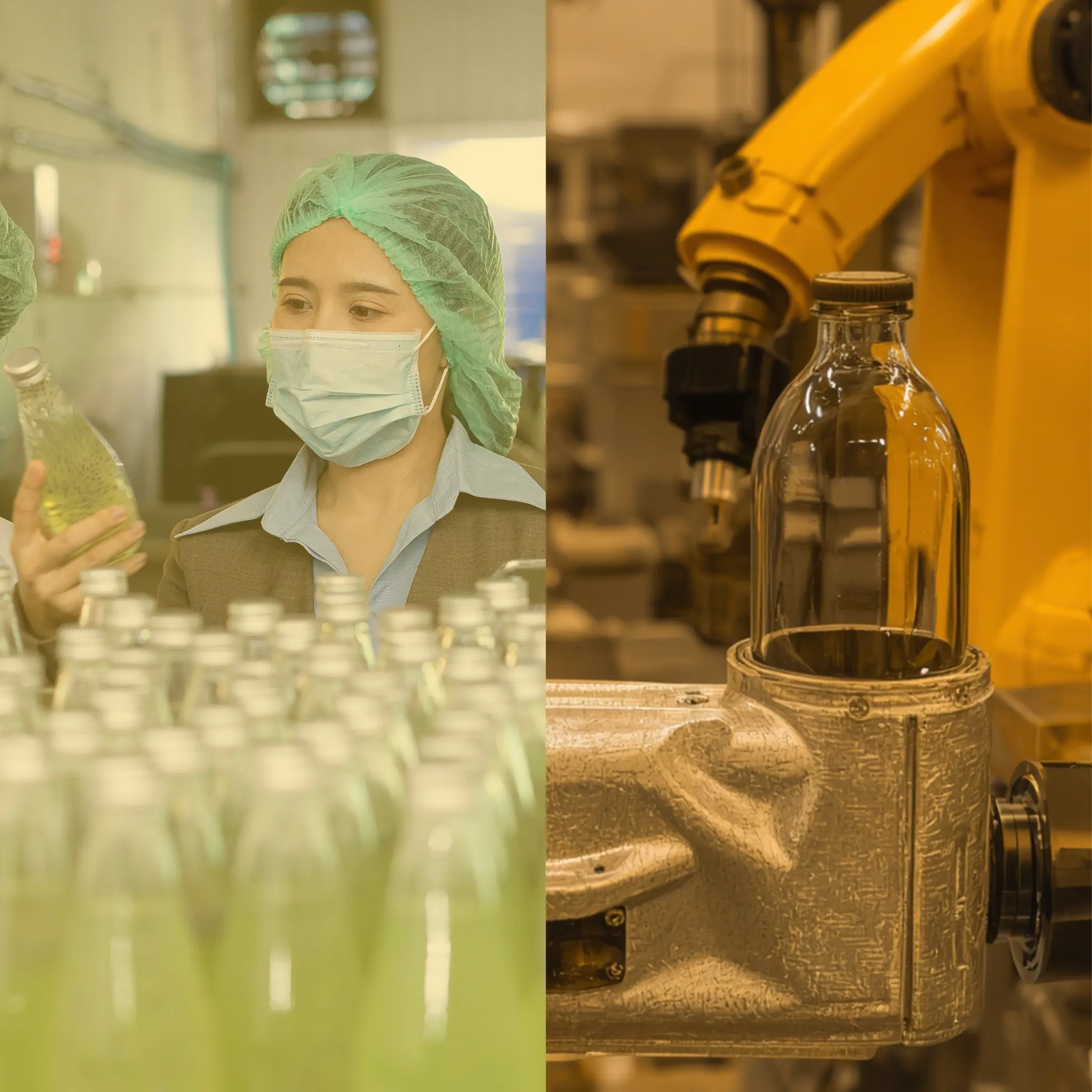
Related Articles
Our Customers









Introduction
The decision between manual and automated visual inspection is one every manufacturer eventually faces. Manual inspection has delivered quality control for generations — it is flexible, requires no capital investment, and leverages human judgement for complex decisions. Automated visual inspection brings consistency, speed, and traceability that manual methods cannot match at scale.
This guide provides a structured comparison of manual vs automated visual inspection across the dimensions that matter for manufacturing quality decisions: coverage, accuracy, speed, cost, traceability, and flexibility. Understanding these trade-offs is essential for making the right inspection investment for your production context.
Where Manual and Automated Inspection Differ
Coverage
Manual inspection is limited to sampling — physically impossible to inspect 100% of units at production speeds above 60 units per minute. Automated inspection delivers 100% coverage at speeds up to 1,000 units per minute.
Consistency
Manual inspection accuracy degrades 20–30% after one hour due to fatigue. Automated inspection delivers identical performance on unit 1 and unit 1,000,000 — no shift-to-shift or inspector-to-inspector variability.
Traceability
Manual inspection produces paper records at best — incomplete, retrospective, and inadmissible as evidence of 100% inspection. Automated inspection logs every result with timestamp, image, and defect classification.
Total cost
Manual inspection appears lower cost but carries hidden costs: defect escapes, recalls, rework, regulatory exposure, and scaling limitations. Automated inspection delivers lower total cost of quality at any production volume above a few hundred units per day.
Manual Visual Inspection — How It Works and Where It Fails
Manual visual inspection relies on trained human inspectors examining products against defined acceptance criteria. Inspectors may use visual aids — magnification, standard samples, go/no-go gauges — and follow structured inspection procedures. For low-volume, complex, or high-variability products, human judgement remains valuable and cost-effective.
The structural limits of manual inspection emerge at volume. Research by the Human Factors and Ergonomics Society shows that inspection accuracy degrades 20–30% after one hour of continuous monitoring — not because inspectors become careless, but because sustained visual attention is physiologically limited. This is not a training or motivation problem. It is a fundamental constraint of human visual cognition.
At production speeds above 60 units per minute, 100% manual inspection becomes physically impossible. Manufacturers resort to statistical sampling — inspecting 1 in 10, 1 in 100, or 1 in 1,000 units. Sampling can estimate defect rates but cannot prevent defective units from shipping. Every sampling-based inspection programme accepts a calculable escape rate.
Automated Visual Inspection — How It Works and What It Delivers
Automated visual inspection replaces human inspectors with industrial cameras, controlled lighting, and inspection software — either rule-based or AI-based. The system inspects every unit at production speed, applying consistent criteria regardless of shift, operator, or production volume.
Rule-based automated inspection uses pre-programmed thresholds — if pixel count in a defined region exceeds a threshold, reject. This works for simple, stable defect types but requires specialist engineering to deploy and maintain, and breaks when products or defect types change.
AI-based automated inspection trains a deep learning model on images of good products. The model learns the full distribution of acceptable appearance and detects any deviation — including novel defects never explicitly programmed. New products train in hours. The system improves continuously with new production data.
Both approaches deliver 100% inspection coverage, objective and consistent results, and complete digital traceability — the three things manual inspection structurally cannot provide at production scale.
How AI-Powered Inspection Outpaces Rule-Based Quality Inspection
Traditional rule-based quality inspection systems rely on predefined conditions, thresholds, and fixed logic to identify defects. While effective for repetitive and highly controlled environments, these systems often struggle with variations in lighting, texture, orientation, and complex defect patterns. Even minor production changes can require extensive reprogramming and recalibration, making rule-based inspection difficult to scale in modern manufacturing environments.
AI-powered visual inspection overcomes these limitations by learning directly from production data instead of depending on hard-coded rules. Using advanced machine vision and deep learning algorithms, AI inspection systems can detect complex surface defects, dimensional inconsistencies, scratches, dents, cracks, missing components, and cosmetic anomalies with significantly higher accuracy. Unlike traditional systems, AI continuously improves over time, adapts to process variations, and minimizes false rejects and false accepts.
Another major advantage of AI-powered quality inspection is deployment speed and flexibility. Manufacturers can train AI models with a relatively small set of images and rapidly deploy them across multiple inspection lines and product variants. This enables faster defect detection, reduced manual inspection dependency, improved production throughput, and consistent quality assurance at scale.
As manufacturing moves toward Industry 4.0 and zero-defect production, AI-powered inspection systems are becoming the preferred alternative to conventional rule-based vision systems. They provide greater adaptability, higher detection accuracy, real-time analytics, and long-term scalability for smart factories and automated production environments.
DeepInspect®- Best AI- Powered Visual Quality Inspection Software
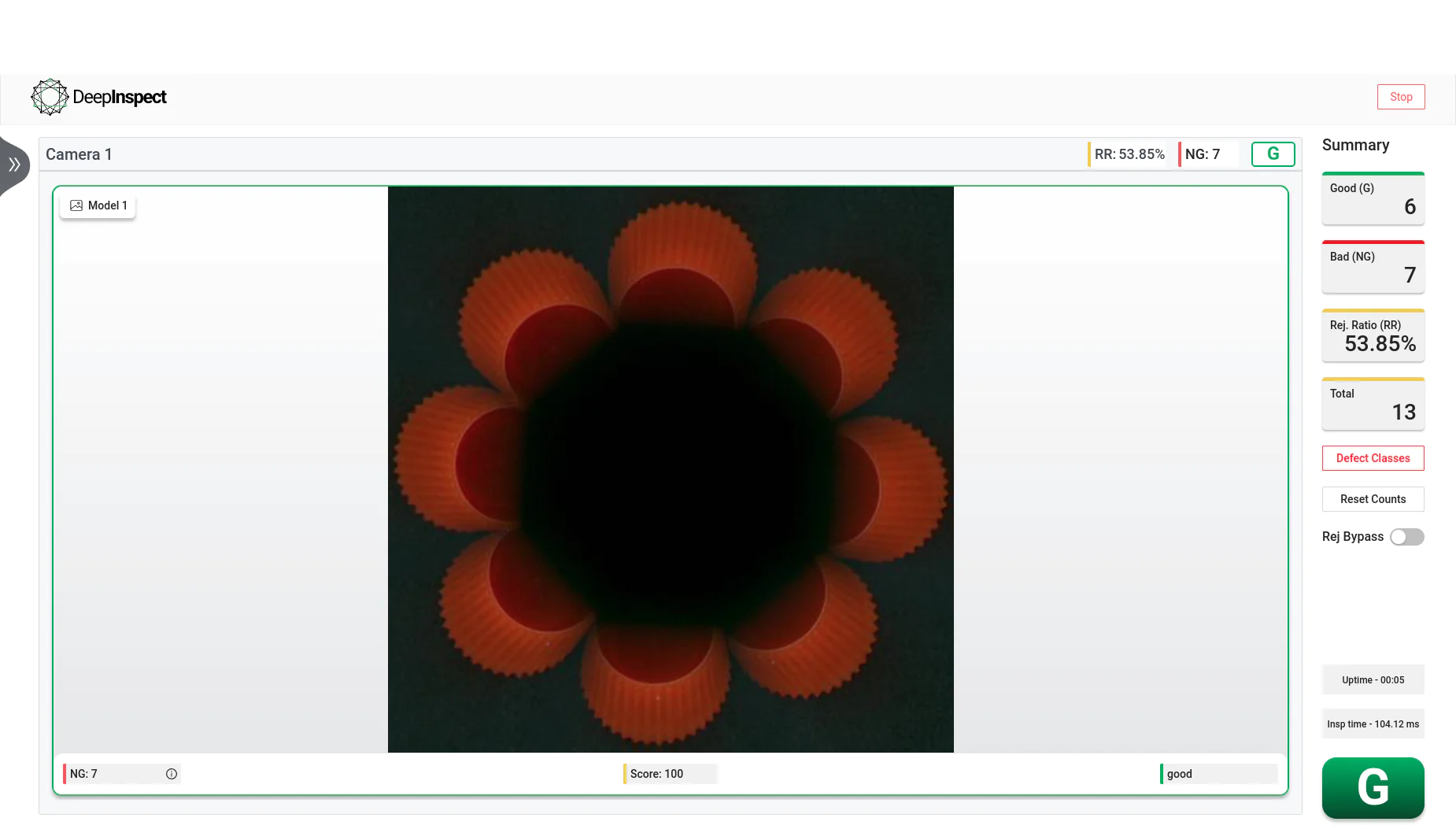
DeepInspect® is an advanced AI-powered visual quality inspection software designed to help manufacturers achieve zero-defect production with unmatched accuracy and speed. Built for modern manufacturing environments, DeepInspect® uses artificial intelligence and deep learning to automate defect detection across automotive, FMCG, electronics, pharma, packaging, and industrial manufacturing applications.
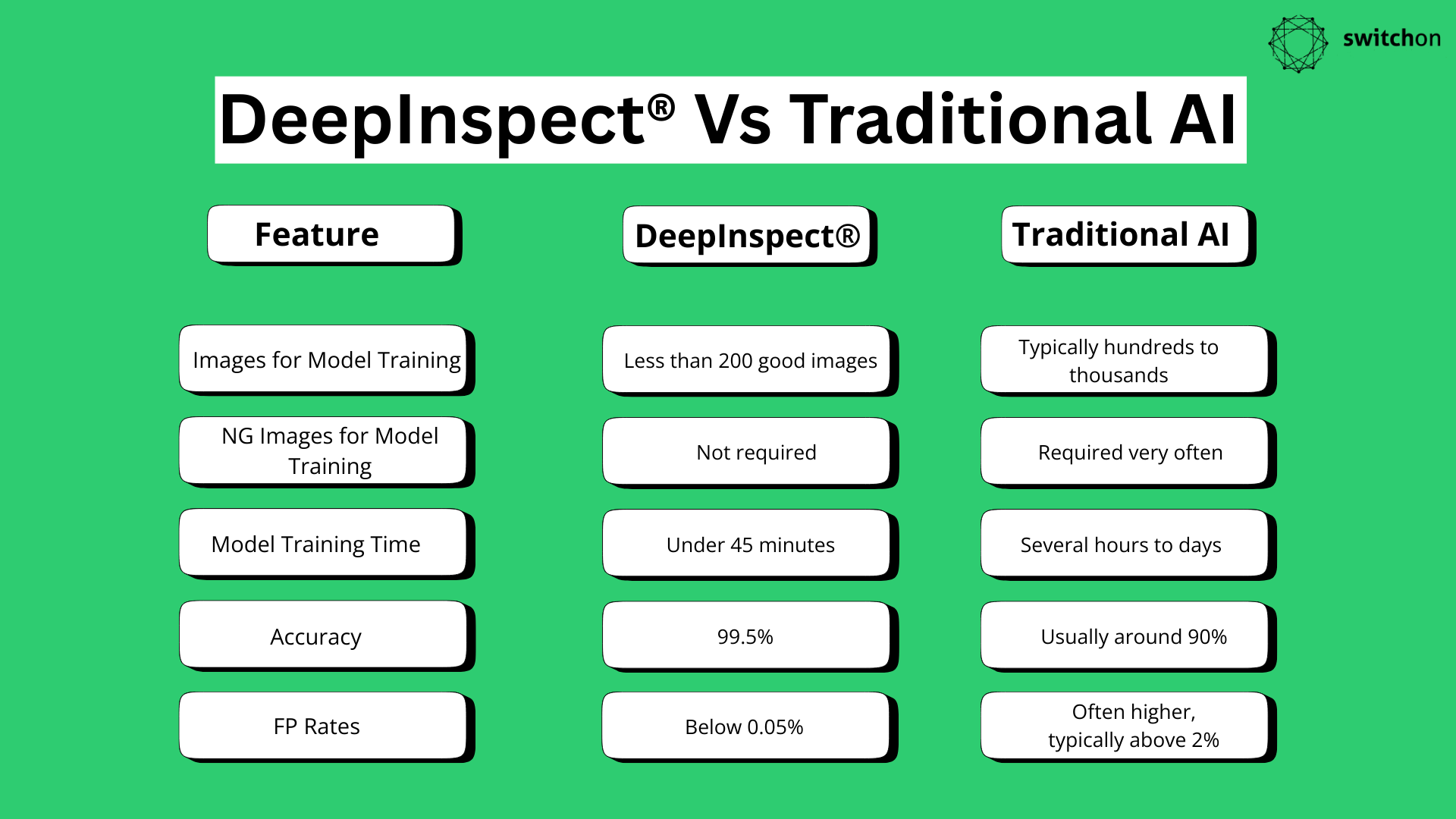
Unlike traditional rule-based machine vision systems, DeepInspect® can identify complex surface and internal defects with up to 99.5% inspection accuracy, even in challenging production conditions. The platform detects scratches, dents, cracks, burrs, missing components, sealant issues, cosmetic defects, dimensional variations, and other critical quality defects in real time.
DeepInspect® requires fewer than 200 good images for training and can be deployed within days, making it one of the fastest and most scalable AI visual inspection systems for manufacturers. Its adaptive AI models continuously learn from production variations, reducing false rejects and minimizing manual inspection dependency.
The software seamlessly integrates with existing cameras, PLCs, production lines, and industrial automation systems, enabling manufacturers to improve product quality, reduce inspection costs, increase throughput, and ensure consistent quality control across high-speed production environments.
With real-time analytics, edge deployment capability, rapid model training, and support for multiple manufacturing use cases, DeepInspect® empowers industries to transition toward smart manufacturing and Industry 4.0 quality inspection standards.
Why DeepInspect®?
- Replaces manual inspection with 100% AI coverage at up to 1,000 units per minute
- Trains on fewer than 200 good product images — no defect catalogue needed
- Delivers 99.5% accuracy vs 70–85% for manual inspection under sustained monitoring
- Complete digital traceability: every unit linked to its inspection image and result
- False positive rate below 0.1% — good products stay on the line
- Line trial achievable within 1 day; full deployment in 1–3 days
Conclusion
Manual and automated visual inspection are not competing philosophies — they are tools suited to different production contexts. The question is not whether to have human inspectors, but where human judgement genuinely adds value that automated systems cannot replicate, and where automation delivers better outcomes.
For any manufacturer running more than a few hundred units per day, requiring regulatory traceability, or experiencing inconsistent quality outcomes from manual inspection, automated AI visual inspection is the answer. DeepInspect® provides this capability — deployable in under a day, with no specialist machine vision engineering required.
Let's Discuss How We Can Transform Your Operations!
Ready to move from manual to automated visual inspection? See how DeepInspect® performs on your product.
Inquiry Form
Manual inspection has four structural limitations: accuracy degrades 20–30% after one hour; 100% coverage is physically impossible at speeds above 60 units per minute; there is no digital traceability; and results vary between inspectors, shifts, and sites.
Automated inspection outperforms manual whenever production speed exceeds 60 units per minute, 100% coverage is required, regulatory compliance demands digital traceability, or quality outcomes vary between shifts or sites. For most manufacturers running continuous production lines, automated inspection delivers better outcomes at lower total cost of quality.
For most manufacturers running more than 200 units per day, automated inspection delivers lower total cost of quality within 12–24 months — accounting for reduced scrap, rework, recall exposure, and labour costs.
For inline production inspection at volume, AI-based automated inspection delivers higher accuracy and 100% coverage that human inspection cannot match at scale. Human inspectors remain valuable for complex judgement calls, exception handling, and incoming goods inspection of irregular materials.
ROI calculation includes: reduction in customer complaints and warranty claims, reduction in scrap and rework costs, reduction in inspection labour costs, regulatory compliance cost avoidance, and the value of 100% inspection data for process improvement. Manufacturers typically see payback within 6–18 months.