

What is Visual Quality Inspection?
A Complete Guide

Related Articles
Our Customers









Introduction
Every product that leaves your production line carries your brand’s reputation. A single defective unit reaching a customer can trigger returns, regulatory action, or recalls that cost far more than the product itself. Visual quality inspection is the discipline that stands between your production process and your customer.
This guide explains what visual quality inspection is, how it works across manufacturing environments, why traditional methods fail at scale, and what modern AI-based systems make possible — for quality managers, plant engineers, and operations leaders evaluating their inspection approach.
What is Visual Quality Inspection?
Definition
Visual quality inspection is the process of examining a manufactured product — using human eyes, machine vision cameras, or AI-powered software — to confirm it meets defined quality standards before it moves to the next stage or ships to a customer.
Scope
It covers surface defects (scratches, cracks, dents, stains), dimensional accuracy, functional integrity (seal quality, fill level, component presence), and traceability (label correctness, barcode readability, date code verification).
Where it happens
Visual inspection occurs at three points: incoming material inspection (before raw materials enter production), in-process inspection (at key line stages), and final inspection before shipment. Each serves a different quality gate.
Who it affects
Every industry that manufactures physical products — automotive, pharmaceuticals, food and beverage, electronics, FMCG packaging, textiles, and industrial components. The stakes differ but the inspection challenge is universal.
How Visual Quality Inspection Works
1. Product presentation- The product is positioned at a consistent orientation and speed — on a conveyor, rotary table, or inline fixture. Consistency is critical: small variations in position or distance from the camera directly affect reliability.
2. Image capture- Industrial cameras capture images under controlled lighting. Area scan cameras capture a 2D frame for discrete products; line scan cameras build images line-by-line for continuous webs or 360° cylindrical inspection. Lighting design is equally critical — ring lights, backlights, coaxial, and dome lights each reveal different defect types.
3. Image analysis- In rule-based systems, engineers pre-program thresholds. In AI-based systems, a deep learning model detects any deviation from what a good product looks like — without explicit rules.
4. Pass/fail decision- The system classifies the product within milliseconds — fast enough for speeds up to 1,000 parts per minute.
5. Rejection and logging- Defective products are automatically removed. Every inspection is logged with a timestamp, image, and defect classification — creating a complete digital quality record.
Types of Defects Visual Inspection Detects
Surface defects: Scratches, cracks, pinholes, dents, stains, discolouration, and coating failures (peeling, blistering). The most commonly inspected defect category across all industries.
Dimensional defects: Incorrect length, diameter, wall thickness, or feature position. Detected using calibrated vision measurement — critical for precision engineering components.
Assembly defects: Missing components, incorrect orientation or polarity, wrong placement. Critical in electronics, automotive assembly, and pharmaceutical manufacturing.
Packaging and seal defects: Open or weak seals, missing caps, incorrect fill levels, damaged packaging. The primary failure mode in food, beverage, and pharmaceutical production.
Label and print defects: Missing or misaligned labels, unreadable barcodes, blurred date codes, OCR/OCV failures. Compliance-critical in regulated industries.
Contamination: Foreign particles, inclusions, chemical residues. The most severe category — carrying direct safety implications in food, pharma, and electronics.
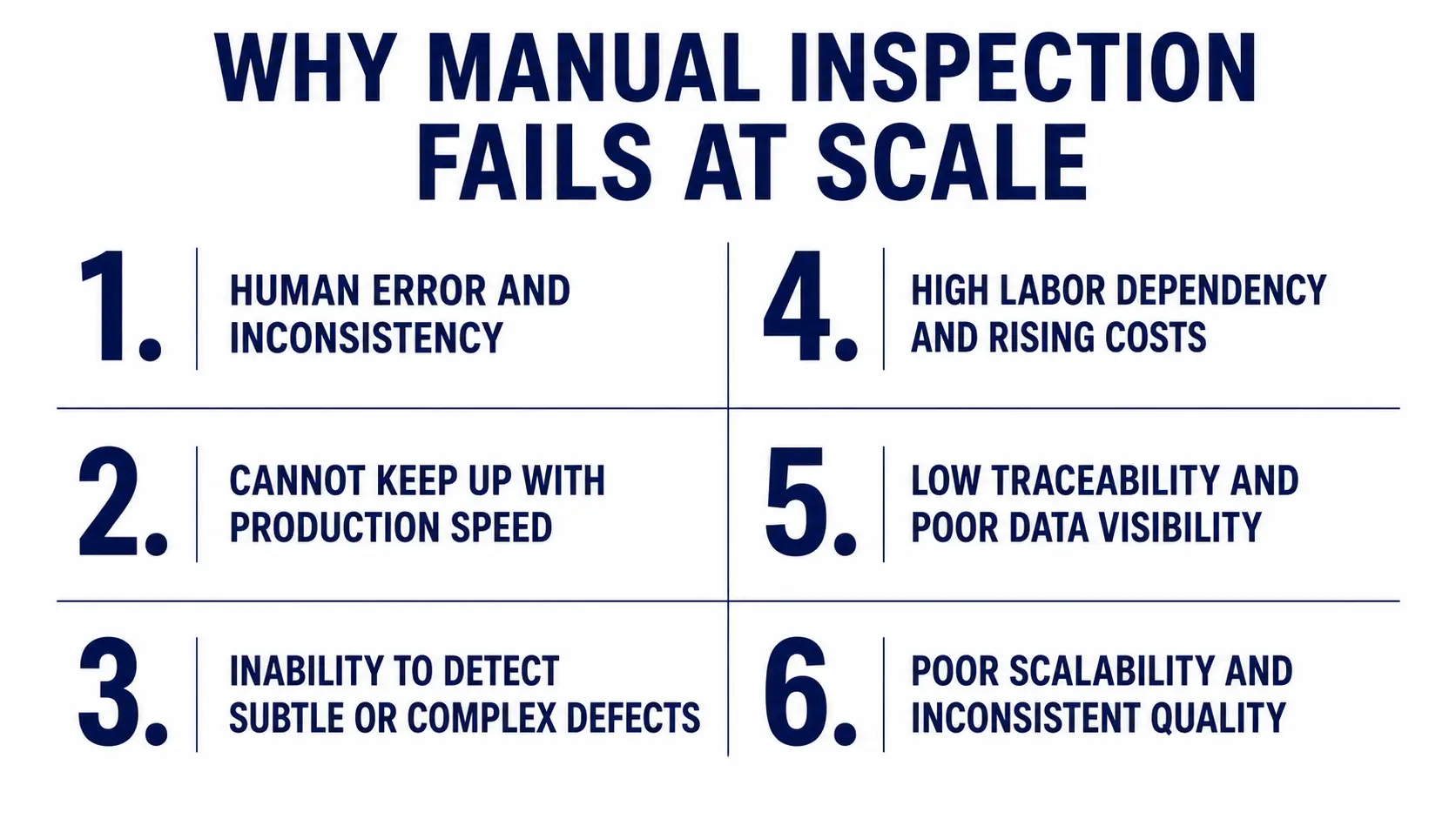
Why Manual Visual Inspection Fails at Scale?
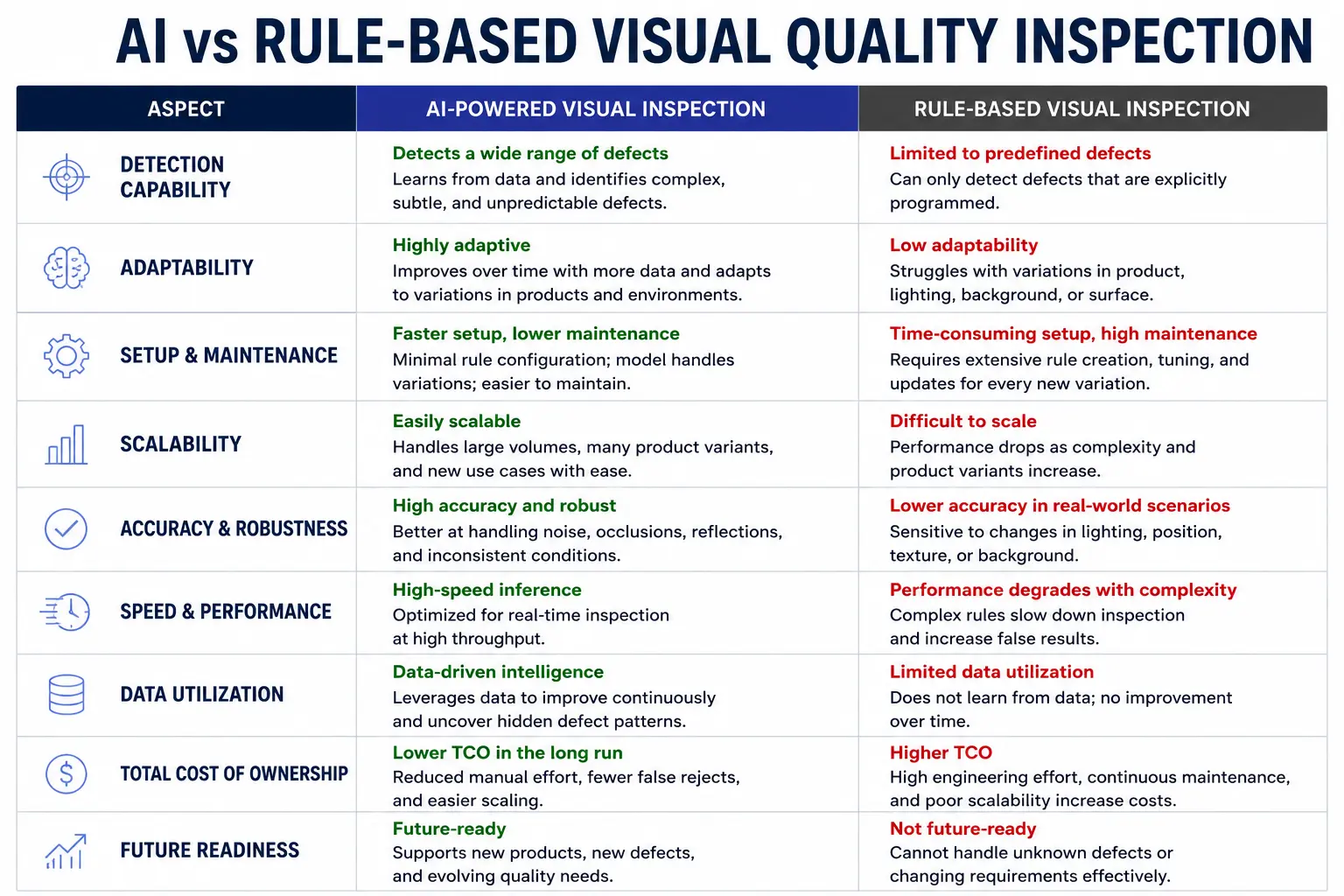
Rule-Based vs AI-Based Visual Inspection
Research shows inspection accuracy drops 20–30% after just one hour of continuous monitoring. At 300 units per minute, manual 100% inspection is physically impossible — manufacturers resort to sampling, meaning defective products regularly ship undetected.
Rule-based machine vision requires engineers to manually program every detection rule. It works for simple, consistent defect types but breaks down when defects are complex or variable, when products change, or when new defect types emerge. Every change requires weeks of re-engineering.
AI-based visual inspection uses deep learning (CNNs) trained on images of good products. It learns normal appearance and flags any deviation — including novel defects never explicitly programmed. New products train in hours. False positives are dramatically reduced. The system improves continuously through retraining.
DeepInspect®- Best AI-Powered Visual Quality Inspection Software
DeepInspect® is an AI-powered visual quality inspection software built to help manufacturers achieve zero-defect production through intelligent automation. It delivers up to 99.5% defect detection accuracy for surface defects, dimensional inspection, assembly verification, and internal component inspection across high-speed production lines.
As an advanced visual quality inspection software, DeepInspect® replaces traditional rule-based inspection systems with adaptive AI models that can identify scratches, dents, cracks, burrs, missing components, sealant issues, contamination, and other manufacturing defects in real time.
The platform requires fewer than 200 good images for AI model training and can be deployed within days, making it one of the fastest and most scalable industrial inspection solutions for modern factories.
DeepInspect® supports a wide range of manufacturing applications, including automotive inspection systems, FMCG quality inspection, pharmaceutical packaging inspection, electronics defect detection, and machine vision quality control.
Why DeepInspect® for Visual Quality Inspection?
- Requires fewer than 200 good images for AI model training
- Model training completes in under 45 minutes
- Line trial achievable within 1 day
- Delivers 99.5% inspection accuracy
- False positive rate below 0.1%, reducing unnecessary manual checks
- Supports up to 1,000 parts per minute inspection speed
- Area scan, line scan, and thermal camera support
- Full integration with PLC, MES, and ERP systems
- Proven across 1,000+ unique SKUs in automotive, pharma, electronics, and FMCG
Conclusion
Visual quality inspection is the backbone of modern manufacturing quality assurance. The industry is shifting from sampling-based manual inspection to 100% automated AI inspection — operating at line speed, generating full traceability, and improving continuously.
DeepInspect® is SwitchOn’s AI-powered visual quality inspection software, purpose-built for manufacturing production lines. It trains on fewer than 200 good product images in under 45 minutes. A line trial is achievable within 1 day. It delivers 99.5% accuracy with false positives below 0.1% — across 1,000+ unique SKUs in automotive, pharma, electronics, and FMCG.
If you are evaluating your visual inspection approach — starting from manual inspection or replacing a legacy rule-based system — DeepInspect® is the fastest path to production-ready AI inspection on your line.
Interested in Automating Visual Quality Inspection using AI?
Book a free demo!
Visual quality inspection specifically uses cameras, optics, and software to examine a product's physical appearance — surface condition, geometry, label accuracy, and seal integrity. General quality control is a broader discipline including process monitoring, statistical sampling, and documentation. Visual inspection is the detection layer — the mechanism that catches non-conforming products before they move downstream.
Visual inspection should happen at three points: incoming material inspection before raw materials enter production, in-process inspection at critical line stages where defects are created, and final inspection before shipment. The highest ROI comes from inline in-process inspection — catching defects at the point of creation, before they accumulate further production value.
Research shows inspection accuracy drops 20–30% after just one hour of continuous monitoring — regardless of training level. At typical production speeds of 200–600 units per minute, 100% manual inspection is physically impossible. Manufacturers default to statistical sampling, meaning defective products regularly escape. Additionally, manual inspection produces no digital traceability — a requirement for FDA, EU GMP, and IATF 16949 compliance.
Rule-based machine vision requires engineers to manually define every defect type — it only detects defects it was explicitly programmed for and breaks when conditions change. AI-based inspection like DeepInspect® trains a deep learning model on images of good products. It learns what normal looks like and flags any deviation — including novel defect types never anticipated. AI systems deploy faster, adapt to product variation, and deliver far lower false positive rates.
DeepInspect® is one of the best AI-powered visual quality inspection software platforms for manufacturing industries. It delivers up to 99.5% defect detection accuracy, requires fewer than 200 good images for training, and can be deployed within days. DeepInspect® helps manufacturers automate defect detection, reduce manual inspection dependency, and achieve zero-defect manufacturing across automotive, FMCG, pharma, electronics, and industrial production lines.
It depends on the product geometry and inspection requirement. Flat or single-face products typically require one camera. 360-degree inspection of cylindrical products — bottles, caps, spark plugs — can be achieved with as few as two cameras using specialised optics, as demonstrated by DeepInspect® inspection systems which replace traditional 4+ camera setups without sacrificing coverage.